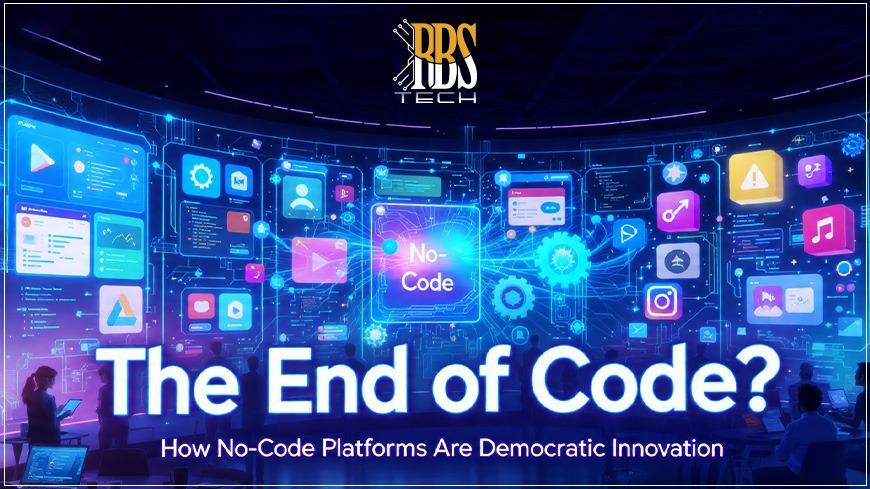
Imagine creating a website, workflow, or application that works flawlessly without writing any code. Doesn’t no-code platforms sound impossible? No longer. Greetings from the no-code revolution, a movement that is revolutionizing the way companies innovate, grow, and address issues.
Marketers, designers, and entrepreneurs can all become creators with no-code platforms. The user-friendly drag-and-drop interfaces and AI-powered tools are a lifesavers.
Does coding as we know it, however, truly come to an end with this?
A No-Code Platform: What Is It?
Without knowing how to program, users can create and implement software applications using a no-code platform.
These platforms automate the back-end complexity of coding through integrations, pre-built logic, and visual interfaces.
Well-known instances include:
- Bubble: Visually create web applications
- Airtable is a database and spreadsheet hybrid.
- Zapier: Automate inter-app workflows
- Create and manage responsive websites with Webflow.
The objective? Quickly bring concepts to life without the need for costly development teams.
The Reasons No-Code Is Growing
The emergence of no-code is a reaction to three significant digital challenges, not merely a fad:
- Developer Shortage: There may be an 85 million developer shortage worldwide by 2030.
- Business Agility: Businesses and startups must introduce products more quickly than in the past.
- Innovation bottlenecks: Growth is slowed when tech teams must wait weeks to implement basic ideas.
No-code tools encourage innovation from within by enabling business users to take initiative, test concepts, and iterate rapidly.
Democratizing Innovation with No-Code Platforms
1. Encouraging Citizen Developers
Anyone in an organization can become a “citizen developer” using no-code tools.
These people comprehend business requirements and, without formal coding knowledge, develop solutions using no-code tools.
2. Cutting Down on Time-to-Market
Months pass during traditional development cycles. Businesses can launch with no-code in a matter of hours or days.
Startups and SMEs have a significant competitive advantage thanks to this speed.
3. Reducing the Cost of Development
It is expensive to hire qualified developers. By doing away with that dependency, no-code preserves scalability while cutting development costs by as much as 70%.
4. Promoting Innovation and Experimentation
- Teams are more inclined to try new things when the tools are easy to use and available.
- Faster innovation and innovative problem-solving are the results of this experimentation.
No-Code vs. Low-Code: What’s the Difference?
| Feature | No-Code | Low-Code |
| Skill Requirement | No programming needed | Basic coding required |
| Users | Business professionals | Developers and IT teams |
| Flexibility | Moderate | High |
| Use Cases | MVPs, websites, internal tools | Complex enterprise apps |
| Examples | Webflow, Glide | OutSystems, Mendix |
Both seek to quicken the digital transformation process, but non-technical innovators prefer no-code because of its emphasis on speed and accessibility.
Examples of No-Code Innovation in the Real World
Airbnb MVP: Prior to scaling, the founders used straightforward, code-free tools to test their concept.
L’Oréal: To improve efficiency, the company developed internal workflow apps with no-code tools.
Startups and solopreneurs: Create apps with AI, SaaS, and e-commerce features without hiring developers.
No-code is changing who can innovate, from large corporations to small creators.
Also Read: ArtificiaI Intelligence (AI) vs. Human Intelligence: Who’s Winning the Innovation Race?
Is Code Coming to an End?
Not exactly. No-code platforms make creation easier, but developers will always be essential.
Deep coding skills are still necessary for complex systems, AI models, and sophisticated integrations.
But the future is hybrid, with no-code ecosystems facilitating smooth collaboration between non-technical teams, developers, and designers.
This change signifies the evolution of creation rather than the demise of code.
Our Two Cents
No-code platforms are revolutionizing innovation by enabling universal innovation, limitless creativity, and accessible technology. Besides, it enables you to develop, test, and scale ideas quickly, regardless of your role startup founder, marketer, or corporate leader.
Use RBS Tech to Strengthen Your Digital Vision
With AI-driven automation, no-code development, and digital transformation tactics that spur growth and innovation. We at RBS Tech assist companies in embracing the future.
Without knowing any code, work with RBS Tech to make your next big idea a reality.